When Will Musical ly Fame Be Back Up Again
'I Wanted to Be Musical.ly Famous. I Really Practiced Those Manus Motions.'
The influence (and aftermath) of an app that only a teen could love.
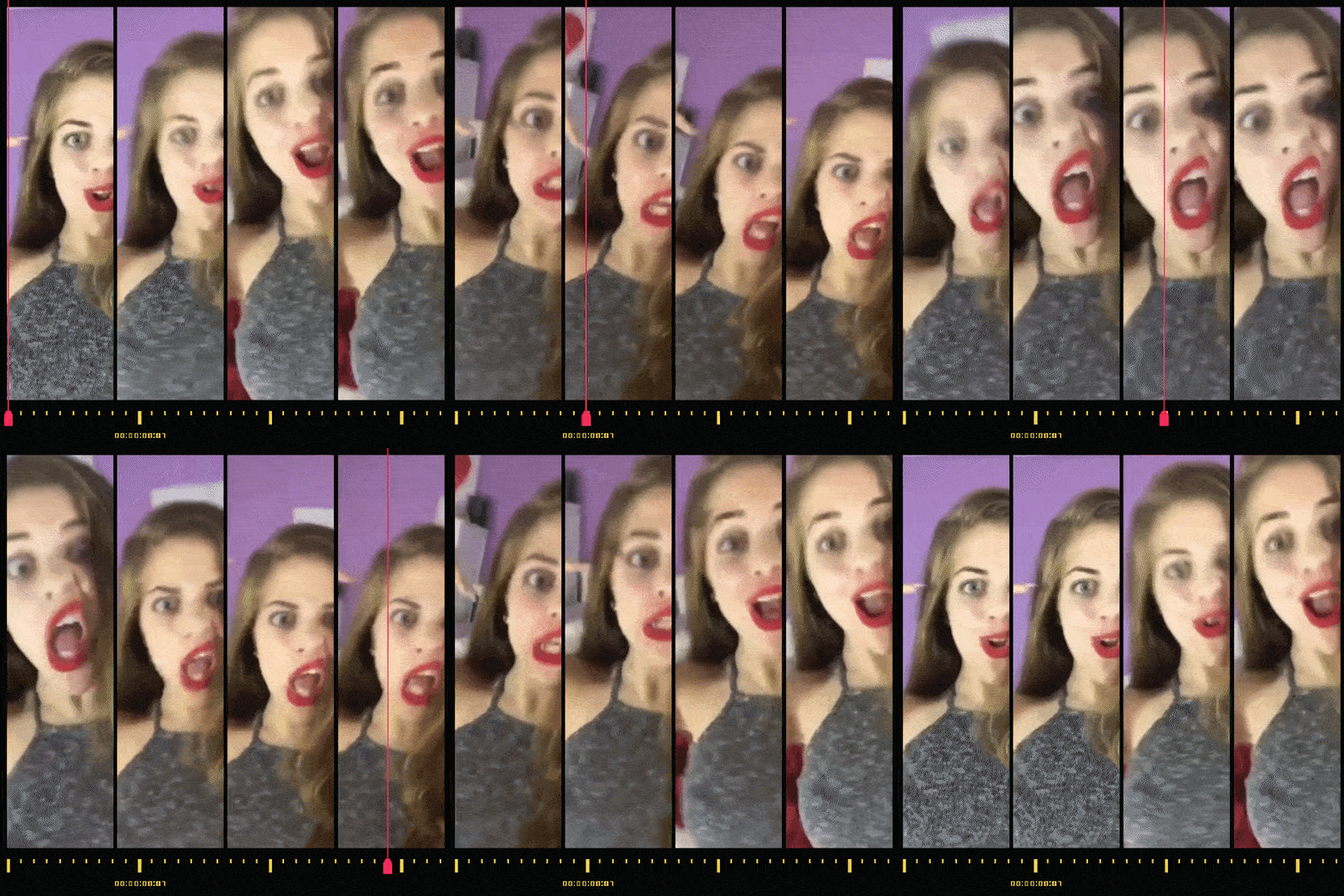
Photo-Illustration: by Vulture; @babyariel
Photo-Analogy: by Vulture; @babyariel
Before he was a member of the Sway Business firm — an L.A.-based, fratlike collective of steely jawed TikTokers who brand ungodly amounts of money gyrating into their camera phones — Blake Gray was the laughing stock of his high school. If you'd seen him and so, in 2016, it wouldn't make sense: He looked like one of the popular boys, a blond Justin Bieber in distressed jeans and backwards baseball caps. But Gray had an online identity that compromised his IRL social standing: He was Musical.ly famous.
From 2022 to 2018, the Chinese app Musical.ly was where kids — as in, literal children and very immature teenagers — would lip-sync to 15-second clips of Shawn Mendes and Bebe Rexha songs, or peradventure an audio rail of a funny Vine. The music played as you recorded; yous could slow information technology down and speed it upward and make cuts while filming. That was pretty much the extent of its technical features, and if it sounds like TikTok, that's because it eventually became TikTok, after it was acquired past another Chinese tech company.
But if TikTok is where all the cool kids hang out at present, Musical.ly was, well, not. Gray's videos were mostly of himself, alone in his room, lip syncing to sped-up versions of Bieber or whatever hip-hop songs were popular at the fourth dimension. "The outset twenty-four hours of [ninth course], I walked in to go observe my schedule, and there were maybe 4,000 kids in 1 room, and everyone was screaming my proper noun," Gray, 20, recalls. "'Oh, it's the Musical.ly kid!' It was awful." He dropped out after Christmas break to pursue a career online.
Gray now has a half dozen-pack and an army of fans all over the world. He's doing fine, which is why he can look dorsum on the content he made every bit a teenager and feel grateful for it rather than horrifically embarrassed. Musical.ly was the genesis of a way of digital filmmaking so weird and goofy that it produced entirely new means to either humiliate oneself or get a worldwide sensation. The app was responsible for some of the cheesiest videos on the internet, many of which had niggling artistic value beyond parroting what someone more famous had posted first. And even so, when washed specially well, they offered users the opportunity to potentially print millions of strangers with a swoosh of an arm and a strategically timed smirk. While the earlier video app Vine was immortalized in wistful eulogies about its comedic significance when it went offline, Musical.ly has been considered (by adults) to be Vine's cringey, junior analogue. Just only one of these apps became TikTok, the defining app of a generation. Perhaps it's time to reconsider its legacy.
"People made fun of information technology," recalls Example Walker, an eighteen-year-sometime actor who was discovered on Musical.ly when he was in middle school. "And then would go home and that's all they'd watch."
Musical.ly was supposed to be a serious app. Its co-founder Alex Zhu had previously worked as a product manager at the software megalith SAP, and his original idea had been to build a shortform educational video platform where kids could lookout man three- to 5-infinitesimal lessons on math, scientific discipline, or other fields of learning, explained by experts. The problem was that information technology is extremely difficult to explain calculus in three minutes; and fifty-fifty if it were possible, no kid would want to watch that.
And then Zhu took a fateful ride. He oft says that Musical.ly was inspired by a group of immature teens he saw on a train almost Google'due south Mountain View campus who were listening to music, taking selfie videos, and sharing them with their friends; Zhu figured he could combine the three activities into a single app. By the summer of 2015, Musical.ly had shot to the No. i spot on the App Store.
Like Vine earlier it, Musical.ly made editing a video together every bit easy as holding downwards a button and lifting your finger when yous wanted it to stop. Unlike Vine, which but allowed users to make half-dozen-2nd-long videos, Musical.ly allowed content upward to 15 seconds long, and then at the very to the lowest degree you could hear a whole poesy of a song. The real innovation, nevertheless, was giving users the power to slow down or speed up the camera's frame rate while keeping the audio runway in sync. For example, if you wanted to film yourself lip-syncing to "Closer" by The Chainsmokers, yous could do information technology in slow motion, mouthing the lyrics to a creepily sluggish version of the song. When you played the video at normal speed, your movements would seem unnaturally nimble and staccato, like a chipmunk vocal consequence for facial expressions.
This was the cornerstone of Musical.ly style, and one-time Musers (every bit they call themselves) know it when they meet it. "They were so addicting to watch," says Haley Sharpe, a now-famous TikToker who remembers idolizing Musical.ly stars in middle school. The videos ofttimes incorporated finger dancing, or "tutting," which was easier to brand await polish and on-beat when filmed in dull motion. "To exist able to make information technology await like you lot're moving the camera and do the hand motions that went along with the lyrics, it just looked really absurd," Sharpe says. "I wanted to be Musical.ly famous. I really practiced those paw motions."
At that place was an unspoken queen of such content: Ariel Martin, a Florida teenager known past her username Baby Ariel, an adept in perfectly syncing her paw motions to the beat. Nearly every Muser I spoke to said they taught themselves how to use Musical.ly by watching her videos. "Musical.ly was an app my friends and I started using to make fun videos and share them just with each other," she said in a 2022 interview. She posted her commencement video in May 2015, when she was 14; within three months, she'd become a bona fide social-media star and began filming popular tutorials on how to principal her signature way. "I sucked at all the hand motions and transitions," says Gray, who once dated Ariel. "She taught me, I'm non gonna lie."
Casual artistic theft was perfectly kosher on Musical.ly, where aspiring entertainers could insert themselves in their favorite films, Idiot box shows, or Vines, using the app'south library of sounds, which included users' own creations also as clips from songs that the company allegedly ripped from iTunes' 15-second previews in order to avoid going through record labels. Some fabricated interim or "POV" videos in which they performed lip syncs to other people'southward one-act sketches or specially entertaining Spongebob scenes. That's non to say creating videos on the app required no talent. Cool transitions, or particularly monumental cuts, were the almost difficult — and most impressive — to master. Musers like Isaiah Howard could make it appear every bit though they'd used sophisticated editing software to create dizzying trompe fifty'oeils, the photographic camera seeming to travel betwixt dimensions, nonetheless the effects were entirely analog. Case Walker found a way to make it look similar he was peeling himself off the screen: "I would take a screenshot of myself and then hold that same pose, print the pic, get catch the newspaper, so put the newspaper in front of the camera, and pull information technology back. People would come up up with crazy stuff."
Before Musical.ly added software that allowed users to edit clips afterward filming them, says 22-year-old Amelia Gething — an actor and TikTok star in London who got her start on Musical.ly in high school — would picture dialogue scenes in which she played two different people past switching costumes and repositioning herself every time she pressed record. "What I took pride in is how I could quite accurately get my hair back in identify and put my outfit and adapt the lighting to how it was and then information technology matched," she laughs. "That was my thing."
Nobody was really making money on Musical.ly. In that location was a companion app chosen Live.ly where popular creators could livestream themselves and receive digital "gifts," signified by emojis that popped up onscreen, yet only the very top tier of creators were raking in thousands. A fan could send a cartoon panda worth five cents, while other emojis could be worth upward to $50, and both Musical.ly and Apple's iTunes took a cut of the creator's acquirement. But without the buy-in of brands, celebrities, or many adults at all, tiptop Musers would typically make money by joining tertiary-party tours that would shepherd creators effectually to suburban malls for meet-and-greets with fans, or by picking up a few hundred bucks for the odd sponsored post.
There was too no algorithm: At that place was a tab that showed yous videos from creators you lot were already following, but instead of TikTok's "For Y'all" page of algorithmically driven suggestions, Musical.ly had a "Featured" page that was actually curated by a human. "I remember showing up to the Musical.ly part one mean solar day, and I was like, 'You lot're the lady that features everyone!'" recalls Walker. "She was like, 'Yep, I printing the button!' It was very authentic." Behind the scenes, co-founder Zhu developed real-life relationships with the families of creators he thought could accept big careers to get their feedback and aid them abound their followings.
Some creators had an easier time getting noticed than others. The teenagers who became famous on Musical.ly, like Blake Gray or Jacob Sartorius or Loren Grey, had an undeniable charisma, or were at least considered attractive enough that their faces were all the charisma they needed — non unlike the pipeline to internet fame later taken by TikTokers like Charli D'Amelio and Addison Rae Easterling. (Sartorius and Gray both later released their own original music, too.) Siblings, especially twins, also got attention on the app; the all-time most-popular users were Lisa and Lena, teenage twins in Germany, maybe because watching two people practice the same motions in 2-time speed looked cooler to viewers than watching one. "In that location'southward this sort of weird, satisfying affair when the ii people expect the aforementioned," explains Harvey Mills, one half of the British popular duo (and twins) Max and Harvey, who were Musical.ly famous before they competed on The Ten Factor in 2019. ("Satisfying" was a word that kept coming upwards in conversations about Musical.ly, equally though it was a kind of visual ASMR.)
Brothers Gilmher and Jayden Croes were commencement fatigued to the app because it was a path to net fame that didn't require speaking. Raised in Aruba, their first language was Papiamento, not English. When they made videos, they relied on exaggerated, Jim Carrey–inspired torso movements and cliche punchlines for laughs. "We did a lot of cringey stuff, I'g not gonna lie," Gilmher says of their sketches, which were normally filmed in two-fourth dimension speed and prepare to trending audio like Charli XCX'southward "Fancy" or monologues from YouTuber Miranda Sings. But they managed to build a community of more than 15 million followers. They were having fun, and they wanted to prove their hometown doubters wrong — that it was possible for two Aruban brothers to be the next big viral sensation.
Then, in 2017, the Chinese tech giant ByteDance bought Musical.ly for nigh a billion dollars. The following August, ByteDance merged information technology with the company's existing platform, TikTok, and overnight, all Musical.ly accounts became TikTok accounts. The company informed its top creators that, along with the rebrand, the app would begin to courtroom older audiences, in what seemed like a articulate attempt to shed its reputation equally a place for 12-twelvemonth-olds to brand dorky videos in their bedrooms. For some of the nearly devoted Musers, opening up the insulated world of Musical.ly was like sticking a needle in a balloon.
A few months subsequently the app had switched over, in November 2018, Jayden Croes uploaded a video of himself and Gilmher lip-syncing to a viral tune made by YouTubers TomSka and the Gregory Brothers called "The Muffin Vocal," in which a father makes a pie for his child. Jayden, playing the son, complains, "Dad, I'k hungry!" while Gilmher, the dad, sings, "Hi hungry, I'm Dad." They filmed it in the pop Musical.ly style: cartoonishly sped-upwardly movement to a popular sound.
But now that the brothers were on TikTok — which was quickly becoming a identify for genuinely inventive comedy by both teens and adults — viewers didn't know what to brand of them. The Croeses were ruthlessly mocked in comments, in TikTok duets, and eventually, on the rest of the internet. Within hours, they deleted the video. They took a break from posting that ended upwardly lasting a yr, just are now back to a regular posting schedule. "Kids, they're so open to annihilation. They adore creativity," says Jayden, looking back. "Now it's like, they judge you for everything you lot do."
Walker attributes that in role to the algorithm. "When the Featured page became the For You lot folio, it took away a lot of the crawly, organic stuff on the app. You lot start thinking, How tin I cater to the algorithm?'" On Musical.ly, users tended to come across most of the videos that their favorite creators posted; TikTok's For Yous page has replaced these familiar faces with whatever the algorithm thinks you lot'd most like to see. That'due south been a boon for TikTok users who love stumbling upon videos they'd never run across otherwise, just it's been harder for Musical.ly creators, who were used to making content for a loyal fanbase.
Yet every Musical.ly star I spoke to still credits that app nigh entirely with kickstarting their career. Walker now has a office on the Comedy Fundamental prove The Other Two, where he plays a parody of himself, a social-media pop star named Chase Dreams. Baby Ariel went on to release several singles to modest success and got a few interim credits on the Disney Channel, including 2020's Zombies 2. Gething was able to translate her Musical.ly career into her own sketch show on the BBC and a function on the Starz miniseries The Spanish Princess.
They look back on Musical.ly the same way their older siblings likely call back Tumblr or LiveJournal or MySpace: They're cornball for an era when digital subcultures were far more difficult for outsiders to stumble upon and infiltrate. They see Musical.ly as a pure online space, from a fourth dimension just earlier every TikTok trend was dissected in the national news and the inner workings of niche Facebook groups came to demand the attention of an unabridged co-operative of journalism. The app was a place to experiment and learn from one other, without worrying that your well-nigh embarrassing moment would cease upward on Television.
"I desire to say to the people that didn't similar Musical.ly, 'Suck it,'" laughs Harvey Mills. "It'southward the reason why we have things like TikTok that y'all're so entertained by every night. Whoever created Musical.ly, I desire to run into them and firmly shake their hands."
- 12 Video Creators on Their Hardest Edit Ever
- 25 Edits That Ascertain the Mod Internet Video
- An Interview With Ton Practice-Nguyen, Creator of the Iconic 'Countdown' Snuggie Video
- In the Messy Land of Internet Video, the Editor Is Male monarch
Source: https://www.vulture.com/article/musically-transitions-baby-ariel.html
0 Response to "When Will Musical ly Fame Be Back Up Again"
Post a Comment